

EUDR Imports into Ireland
A practical customs and compliance guide for SMEs and large businesses
The European Union Deforestation Regulation (EUDR) changes the conditions for placing certain commodities and derived products on the EU market. For an Irish business importing an in-scope product from outside the EU, EUDR compliance is not simply another document for the customs agent. The importer is generally the upstream operator and must complete due diligence before the customs declaration is lodged.
| Deadline check Large and medium enterprises: 30 December 2026. Most micro and small enterprises: 30 June 2027. Micro and small operators already covered by the EU Timber Regulation are subject from 30 December 2026. Business size and supply-chain role must be assessed correctly; “SME” does not automatically mean the later date. |
Some products newly added to Annex I in 2026 are subject to EUDR from 30 December 2027, so businesses should check the current product scope as well as their general business-size deadline.
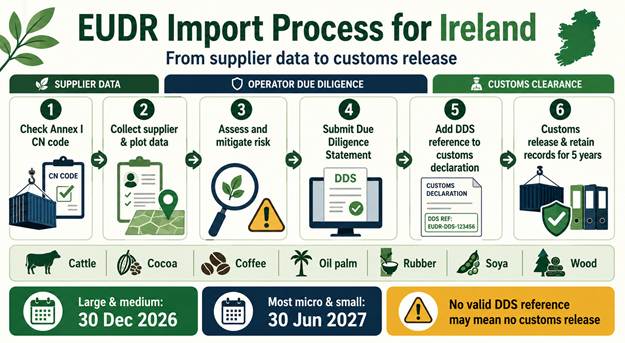
Figure 1. The EUDR evidence and DDS process must be completed before the import declaration is lodged.
EUDR Guide 1: Is your import in scope?
EUDR applies to specified products linked to seven commodities: cattle, cocoa, coffee, oil palm, rubber, soya and wood. It also covers specified derived products under particular CN or HS codes, including certain chocolate, rubber, furniture, paper and wood products. The legal scope is determined by the precise Combined Nomenclature (CN) or Harmonised System code listed in Annex I—not by a broad product description or sustainability label.
| Question | Why it matters |
| What is the exact CN code? | Only products listed in Annex I are caught. A similar product under another code may be outside scope. |
| Does it contain or use a relevant commodity? | A listed code alone may not be enough where the product does not contain or use the relevant commodity. |
| Is this a commercial import? | Private use or consumption is generally outside the operator concept; business imports are the focus. |
| Was it already placed on the EU market? | A genuine re-import may have different downstream obligations if prior EU placement and due diligence can be proved. |
| When was it first placed on the market? | Transitional stock needs reliable evidence of the relevant date; assumptions or undated stock records are unsafe. |
| Packaging is not automatically in scope Packaging used solely to support, protect or carry another product is treated differently from packaging imported or sold as a product in its own right. Classify the actual transaction and product function before deciding. |
EUDR Guide 2: Who is responsible?
Irish importer / upstream operator
The business that releases an in-scope product for free circulation and first places it on the EU market is generally an upstream operator. It must establish a due diligence system, collect the Article 9 information, assess risk, mitigate any non-negligible risk, submit the Due Diligence Statement (DDS), and accept legal responsibility for the product’s compliance.
- Confirm the product is deforestation-free: it must not originate from land deforested after 31 December 2020; wood must also satisfy the forest-degradation requirement.
- Confirm production complied with relevant laws in the country of production, including land-use rights and other applicable legal requirements.
- Reach a conclusion of no risk or only negligible risk before placing the goods on the market.
- Maintain the due diligence system, review it at least annually and retain supporting evidence for five years.
- For non-SME operators, appoint a management-level compliance officer, maintain an independent audit function and publish annual reporting on the due diligence system.
Non-EU supplier or producer
A third-country supplier that merely sells to an Irish importer may not itself be legally subject to EUDR, but the shipment cannot be cleared compliantly unless the supplier provides reliable, verifiable and shipment-linked data. Commercial contracts should make these data obligations enforceable.
- Supply producer and direct-supplier identity details, product description, quantity and country—and where relevant region—of production.
- Provide plot geolocation coordinates; polygon data are required for plots over four hectares for commodities other than cattle. Coordinates must be accurate and linked to the supplied batch.
- Provide the date or production time range and evidence supporting deforestation-free production and legal compliance.
- Maintain segregation and traceability so compliant goods are not mixed with goods of unknown or non-compliant origin.
- Notify the importer of changes to farms, plots, intermediaries, product composition, country, legality evidence or risk indicators before shipping.
| Customs agent versus authorised representative A customs representative prepares or lodges the customs declaration under customs law. An EUDR authorised representative submits a DDS under a written mandate. These are different roles. Appointing either does not transfer the importer/operator’s responsibility for compliance. |
EUDR Guide 3: The import and customs process
1. Map products and roles
Confirm the Annex I CN code, commodity, importer of record, upstream operator, business size and applicable date. Do this at SKU level, not merely by supplier or invoice.
2. Collect the supply-chain dataset
Obtain the description, quantity, country/region of production, geolocation, production date or range, producer and supplier details, and evidence of legality and deforestation-free production. The commercial invoice alone will rarely contain enough information.
3. Validate traceability
Reconcile plot data, producer records, batch or lot numbers, quantities, species where relevant, packing lists, transport documents and invoice details. Investigate gaps, implausible polygons, duplicate plots and unexplained mixing.
4. Assess risk
Evaluate country benchmarking, forest presence and deforestation patterns, legality and corruption risk, indigenous peoples’ claims, document reliability, supply-chain complexity, mixing and circumvention. Certification can support this work but cannot replace it.
5. Mitigate risk
Where risk is more than negligible, obtain additional information, commission independent surveys or audits, change controls or suppliers, or otherwise reduce the risk to negligible. If this cannot be achieved, the product must not be imported for placement on the EU market.
6. Submit the DDS
Register in the EU EUDR Information System and submit the DDS only after due diligence is complete and all required data and intended quantities are available. The operator assumes responsibility when submitting it.
7. Send the reference to the customs declarant
The DDS reference number must be obtained before the customs declaration is lodged. Give it to the customs agent together with the correct CN code, net mass, supplementary units where required, origin/production data and shipment documents.
8. Customs declaration and control
The customs declarant enters the associated DDS reference number or permitted declaration identifier on the import declaration. Customs and the Irish competent authority can validate the reference, select the goods for control, suspend release or request evidence.
9. Release, reconcile and retain
After release, reconcile the imported quantity against the DDS coverage. Keep the DDS, risk file, evidence, customs MRN, invoice, packing list, transport documents and quantity records for at least five years.
What the customs agent will need
| Customs data | EUDR data |
| Importer EORI and representation authority | Operator identity and EUDR Information System registration |
| Invoice, packing list and transport document | Valid DDS reference number or permitted declaration identifier |
| Exact CN/TARIC code | Relevant commodity and country/region of production |
| Customs value, currency and Incoterm | Net mass and supplementary unit matching DDS coverage |
| Origin, procedure and goods description | Evidence of any applicable exemption, transitional treatment or downstream status |
What happens if the DDS reference is missing or invalid?
For an in-scope import, the DDS must normally exist before the customs declaration is lodged. A missing, invalid, mismatched or exhausted reference can lead to declaration rejection, a customs hold, referral to the competent authority, storage and demurrage, delayed delivery, corrective action or refusal of release. Customs clearance does not validate the quality of the operator’s entire due diligence file; the operator remains responsible after release.
EUDR Guide 4: Costs and how to control them
EUDR does not introduce a new customs duty or import VAT rate. Existing customs duty, import VAT and other border charges continue separately. The EUDR cost is mainly the cost of evidence, systems, assurance and delay risk.
| Cost area | Typical drivers | Control measure |
| Product mapping | SKU and CN-code review | Classify once, document the rationale and maintain a controlled scope register. |
| Supplier onboarding | Questionnaires, contracts and training | Prioritise strategic suppliers and use one standard data specification. |
| Geolocation and traceability | Mapping, GeoJSON, batch links | Obtain data before purchase orders; validate files before loading. |
| Risk assessment | Country, legality and forest-risk research | Use risk tiers; apply simplified due diligence only where legally available. |
| Verification | Audits, satellite checks, legal opinions | Target higher-risk suppliers and rely on existing evidence where it is relevant and verifiable. |
| Systems and administration | Information System, API, ERP changes | Integrate EUDR fields with purchasing, inventory and customs instructions. |
| Border delay | Storage, demurrage and missed delivery | Complete DDS checks before dispatch and run a pre-arrival customs validation. |
Legitimate ways to minimise cost
- Start with exact CN-code scope mapping. Do not build due diligence files for products that are genuinely outside Annex I.
- Use low-risk simplified due diligence only where all legal conditions are met. Low-risk sourcing does not remove traceability or information collection.
- Consolidate a DDS across suitable batches or shipments where the traceability and quantities remain controlled. A DDS should not cover a period longer than one year, and the operator remains responsible for every batch covered.
- Use existing FSC, PEFC, Rainforest Alliance or other certification evidence as an input, not as a substitute for EUDR due diligence.
- Write EUDR data, audit rights, change notification and indemnity provisions into supplier contracts before placing orders.
- Integrate purchasing, warehouse and customs data so quantity, CN code and reference-number mismatches are caught before arrival.
- Use an authorised representative for DDS submission if efficient, while retaining internal approval and accountability.
EUDR Guide 5: Common mistakes
- Assuming every product containing an EUDR commodity is in scope
- The current Annex I CN/HS classification needs to be checked. Commodity content alone does not determine scope.
- Confusing the country of dispatch with the country of production
- Goods may be shipped from one country even though the relevant commodity was produced somewhere else.
- Treating certification as the complete EUDR solution
- Certification and third-party evidence can be useful, but the operator still needs to satisfy the obligations that apply to it.
- Receiving location details that do not identify the production area
- An office, warehouse, village or port location is not necessarily the geolocation information required for production.
- Keeping customs and supply-chain data in separate systems without reconciliation
- The quantities, batches, product codes and EUDR reference used throughout the process need to remain connected.
- Leaving EUDR until the shipment is approaching Ireland
- If required supplier or production information is missing, it may be impossible to resolve the issue quickly enough to avoid delay.
- Assuming the customs agent becomes responsible for EUDR
- Customs representation and EUDR responsibility are separate issues.
- What about downstream operators and traders?
- The EUDR obligations are different once products have already undergone the required upstream due diligence.
- Following the 2025 simplifications, downstream operators and traders generally do not need to carry out a new due-diligence exercise or submit another DDS.
- They do, however, have record-keeping and information obligations. The first downstream operator or trader must collect and retain the relevant upstream DDS reference number or simplified declaration identifier. Large downstream operators and traders also have additional Information System registration requirements.
- This is why correctly identifying your place in the supply chain is important before deciding what EUDR process applies.
| The commercial risk is wider than a customs delay Member States must provide effective penalties. For legal persons, the maximum fine available under national rules cannot be lower than 4% of the business’s total annual Union-wide turnover in the preceding financial year. Corrective measures, confiscation and market restrictions may also arise. The practical priority is preventing non-compliant goods from being shipped. |
EUDR Guide 6: Frequently asked questions
Does EUDR apply to every import of wood, coffee or rubber?
No. It applies to commodities and products identified by the Annex I CN/HS codes and meeting the relevant product definition. Classification must be checked product by product.
Is the supplier responsible for filing the DDS?
Usually not where the Irish importer is the first person placing the goods on the EU market. The Irish importer is generally the upstream operator. A non-EU supplier must nevertheless provide the data the importer needs.
Can our customs agent submit the DDS?
Only if separately appointed as an EUDR authorised representative under a written mandate and registered for that role. Ordinary customs representation is not enough.
Does a low-risk country mean no due diligence?
No. Information and traceability remain mandatory. Simplified due diligence removes parts of the risk-assessment and mitigation process only where the conditions are satisfied and no warning information exists.
Can one DDS cover several shipments?
Yes, where all products and quantities are covered, due diligence is complete, records reconcile the shipments and the period is not longer than one year. Multiple DDS references can also appear on one customs declaration.
Must the DDS number appear on the supplier invoice or bill of lading?
EUDR does not generally require it on those documents, but it must be made available to Customs through the customs declaration. Businesses may still include it on commercial documents to improve control.
What if our supplier cannot provide the required production information?
If information required to establish EUDR compliance cannot be obtained, the operator may not be able to lawfully place the affected product on the EU market. This is why supplier readiness should be checked before orders are shipped.
How long must records be kept?
At least five years. The file must allow the business to demonstrate information collection, risk assessment, mitigation, DDS submission and quantity reconciliation.
Is there an official EUDR charge at import?
There is no separate EUDR customs tax. Businesses should budget for internal staff, systems, supplier data, audits, advisory support and possible port-delay costs.
Who enforces EUDR in Ireland?
The Department of Agriculture, Food and the Marine has been designated as Ireland’s competent authority and works with customs authorities on controls and enforcement.
A practical readiness plan
| Timing | Action |
| Now | Create the SKU/CN-code scope register; assign operator roles; identify affected suppliers and imports. |
| Next 30-60 days | Issue supplier data requirements; amend contracts; test geolocation and legality evidence; register and train users in the Information System. |
| Before first live shipment | Complete risk assessments, internal approvals, DDS submission and customs-instruction testing. |
| Ongoing | Reconcile quantities, monitor suppliers and risk signals, review the due diligence system annually and retain records for five years. |
Irish Customs Agents can support businesses with product-scope and CN-code review, customs-process planning, supplier document requirements and the customs-declaration requirements for EUDR-affected imports. We can also help businesses understand what information needs to be in place before shipment so that the EUDR reference and customs data can be aligned correctly.
The strongest approach is to build EUDR requirements into purchasing and pre-shipment checks, rather than treating them as a last-minute customs-clearance issue.
EUDR readiness checklist for Irish importers
Before your first affected import:
- Review the CN code against the current EUDR Annex I.
- Identify the relevant commodity.
- Confirm your role in the supply chain.
- Establish the application date that applies to your business and product.
- Identify affected suppliers and products.
- Give suppliers your EUDR information requirements.
- Obtain and validate the required production and geolocation information.
- Complete the required due-diligence process.
- Submit the DDS where applicable.
- Provide the correct reference and shipment information to your customs declarant.
- Reconcile imported quantities with the relevant EUDR records.
- Retain the required supporting documentation.
Authoritative sources
- European Commission — Regulation on Deforestation-free Products and application dates.
- European Commission — EUDR roles and responsibilities.
- European Commission — Understanding EUDR due diligence.
- Commission Delegated Regulation (EU) 2026/2102 — amendments to Annex I.
- Revenue — eCustoms Helpdesk Notification 28/2025
Information reviewed: 27 October 2026. This article is general guidance, not legal advice or a binding customs determination. EUDR guidance and customs data requirements may continue to develop before application.